
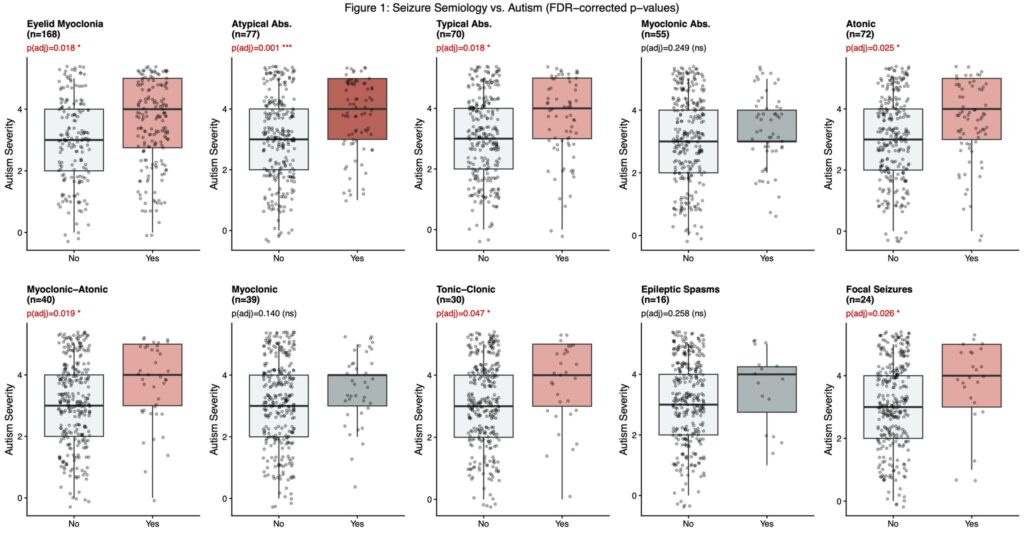
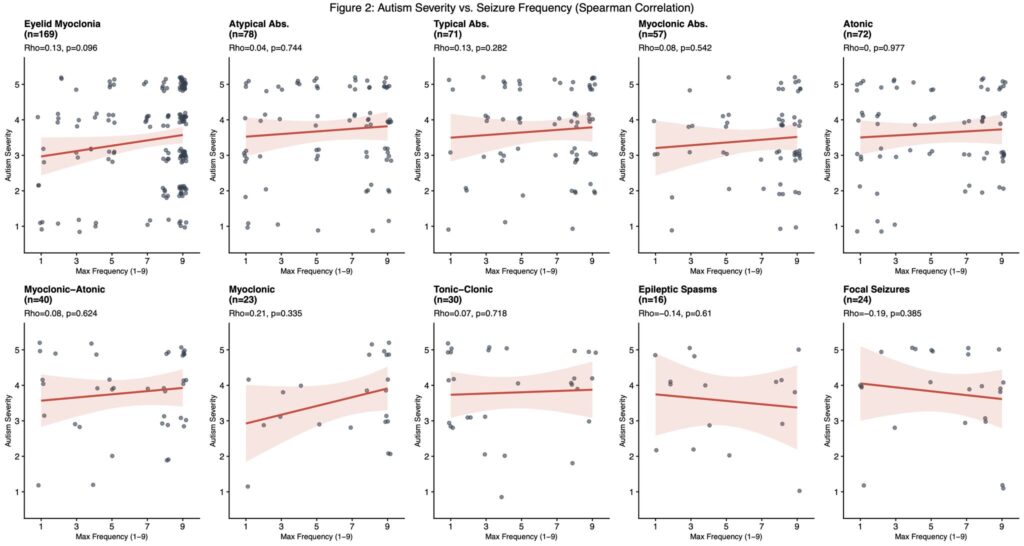
Recently, a new large-scale preprint utilizing data from the PATRE registry (N=337) was published, addressing a long-standing question in the study of developmental and epileptic encephalopathies (DEEs).
Historically, a prevailing clinical assumption suggested that the severity of behavioral challenges in epilepsy patients was directly proportional to how often seizures occurred. While the medical and research communities have recently begun to suspect that this connection might not hold true for DEEs, large-scale empirical data to support this shift in thinking has been lacking.
Our latest publication finally provides the necessary data for SYNGAP1, revealing two crucial clinical takeaways:
- Autism Severity is Independent of Seizure Frequency: Our analysis demonstrates that caregiver-reported autism severity is entirely independent of the maximum caregiver-reported seizure frequency. This finding highlights that the neurodevelopmental burden in SYNGAP1 is highly complex and extends far beyond the simple quantitative counting of seizures.
- Atypical Absences as a Clinical Marker: The data suggests that qualitative factors play a highly significant role. Specifically, the presence—rather than the frequency—of caregiver-reported atypical absences serves as a critical clinical marker associated with higher caregiver-reported autistic behaviors (FDR-adjusted p = 0.001).
The Power of the PATRE Registry
Milestones in DEE research like this are only possible through the dedication of our community. Your willingness to share your daily realities via the PATRE registry is what drives these medical breakthroughs forward.
We extend our deepest gratitude to all participating patients, parents, families, and advocacy organizations. Special thanks to SYNGAP Elternhilfe e.V. & Syngap Global Network (SGN).
We also thank the EURAS Project consortium and all contributing co-authors across Europe.
Read the full preprint here: https://www.medrxiv.org/content/10.64898/2026.04.19.26351217v1